Making Good Things Happen


A blog that informs our clients about real world topics related to what we do as Scale Strategic Solutions!

Leading Without a Title:

What Businesses and Nonprofits Can Learn from Informal Teacher Leadership

At Scale Strategic Solutions, we believe leadership isn’t confined to job titles. It’s about influence, impact, and initiative. As organizations navigate times of transition, many are shifting their focus from aggressive growth to sustainable engagement, maintaining strong customer, donor, and vendor relationships, supporting staff morale, and ensuring the right people are in leadership roles. This kind of stability isn’t a sign of stagnation; it’s a sign of wisdom. It means understanding that growth isn’t always about scaling up. Sometimes it’s about supporting what works. In this space, informal leadership becomes a vital tool for stability and innovation.


Organizations can take a page from the Informal Teacher Leadership Framework. Just as teachers lead informally by sharing resources, mentoring peers, or co-developing lessons, employees can do the same by forwarding new tools, hosting quick skill-shares, or modeling effective communication and teamwork. These frameworks not only foster collaboration across departments but also spark innovation when resources are limited. 


When hiring isn’t an option, creativity becomes the strategy, redistributing responsibilities based on strengths, forming cross-functional teams, or offering professional development as a reward for leadership in action. By encouraging this kind of informal collaboration and recognition, organizations can stretch their capacity, strengthen engagement, and build a culture that thrives on connection, shared learning, and resilience.


Of course, fostering this kind of informal leadership doesn’t happen by accident. It requires intentional support from formal leaders, those who recognize and nurture leadership potential wherever it appears. That could mean giving staff space to innovate, creating mentorship opportunities, cycling tasks among staff as stretch opportunities, or simply recognizing the quiet contributors who carry the culture forward. When organizations invest in these people, they prevent burnout, strengthen retention, and keep purpose alive even during slower seasons.


So, whether you’re leading a nonprofit, a healthcare team, or a corporate department, take a page from the classroom: leadership is a collective effort. When we empower people to lead from where they are, not just from where they’re positioned, we build stronger, more sustainable organizations. Growth may not always mean getting bigger, but it should always mean getting better.


At Scale Strategic Solutions, we help organizations tap into this kind of hidden leadership potential. Through our leadership development and learning solutions, we partner with teams to strengthen culture, nurture collaboration, and reduce burnout, ensuring leaders at every level are equipped to make a lasting impact. Because true leadership isn’t about authority; it’s about influence, empathy, and growth for both people and the organizations they serve.



By m.staples87 April 28, 2026
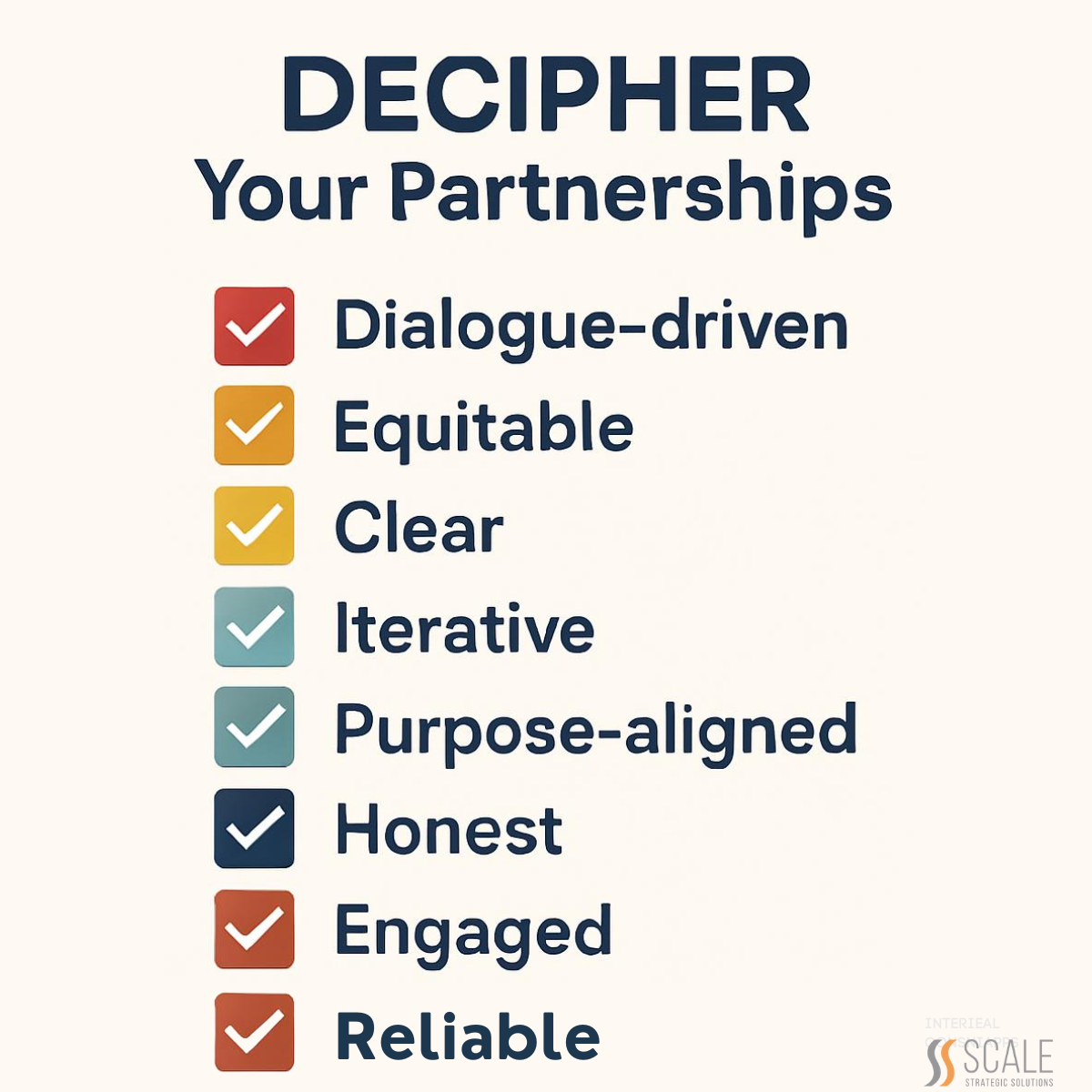
Organizations working in education, health, and social services often face complex challenges. No single group can solve these issues alone. Public agencies, nonprofit organizations, and philanthropy must work together to create lasting impact. Strong collaboration depends on trust. Trust is not automatic. It must be built with intention over time. At Scale Strategic Solutions, we have supported partnerships across sectors. These experiences show that trust is the foundation of effective collaboration. To support this work, we use a simple framework. DECIPHER Your Relationships and Communication This framework helps partners build and maintain trust.  D – Dialogue-driven Trust starts with conversation. Partners need open and ongoing communication. Everyone should have a chance to share ideas and concerns. Regular dialogue helps partners stay aligned. E – Equitable Each partner should benefit from the collaboration. Organizations bring different strengths and resources. Fair exchange matters. Respect each partner’s role, capacity, and perspective. C – Clear Clarity prevents confusion. Define roles, responsibilities, and expectations early. Make sure commitments are easy to understand and act on. Clear agreements reduce conflict. I – Iterative Trust builds over time. Start small and follow through. Use feedback to improve the partnership. Learn together and adjust as needed. P – Purpose-aligned Partners need a shared mission. Clear goals keep everyone focused. When challenges arise, shared purpose helps guide decisions. Alignment around outcomes keeps the work moving forward. H – Honest Collaborators must be transparent and truthful with each other. Address challenges early. Set clear boundaries when needed. Honest communication builds respect. E – Engaged Partners must stay actively involved. Engagement means more than attending meetings. It shows commitment to the work and the relationship. The collaboration has to be beyond transactional. R – Reliable All partners need to own and follow through on commitments. Consistency builds confidence. Accountability strengthens the partnership over time. When commitments do not come to fruition, the responsible party assumes ownership and takes corrective action. Partners also balance shared accountability with shared grace. From Principles to Practice Trust building is a practical skill. We must approach it intentionally and consistently. Communication routines, project management practices, and relationship-building opportunities help hone those skills that reinforce the trust. Trust does not happen by chance. It requires effort and consistency. Use the DECIPHER framework to guide your partnerships. Build trust. Strengthen relationships. Create lasting impact.
Woman giving the okay sign in front of people working in the pacground
March 30, 2026
Transforming Skills into Credentials for Career Success
Youth in a group with arms around each other
January 31, 2026
New online, on-demand training available for CEUs
By m.staples87 December 22, 2025
The end of the year invites us to pause, reflect, and appreciate the tools, resources, and rituals that help us do impactful work. At Scale Strategic Solutions, we spend our days turning information into action, supporting businesses as they clarify their vision, understand their impact, and strengthen their systems.
By m.staples87 November 25, 2025
Why Focus Groups Matter: Turning Community Voices Into Action
October 1, 2025
Pathways and the Columbus New Skills Ready Network
August 19, 2025
In today’s data-driven world, local health departments (LHDs) play a critical role in shaping community health and advancing equity. Yet, to do this effectively, they need more than just national trends, they need access to localized, granular data that reflects the real conditions on the ground.  Data sharing is not only a technical challenge but a strategic community-focused practice. When LHDs collaborate with community organizations such as schools, hospitals, social service agencies and law enforcement, they unlock new pathways to address public health challenges more effectively. Local data allows communities to identify emerging health threats, evaluate the impact of programs, and understand how the Social Determinants of Health influence well-being. Scale Strategic Solutions, in partnership with D.E.E.P. Consultants and Strategik513, is proud to announce the development of a robust, strategic roadmap designed to support public health professionals in leveraging data to improve population health outcomes and reduce disparities. Our team of subject matter experts collaborated closely with the National Association of County and City Health Officials (NACCHO) and local health departments to gain firsthand insights into the challenges and opportunities surrounding data sharing practices. This discovery process informed the creation of two key resources aimed at building data capacity in the field. The "Increasing Data Sharing Capacity for Local Health Departments" asynchronous training, alongside the complementary Data Sharing Resource Guide , are now available on NACCHO University , the organization’s online learning platform. At Scale, we are committed to advancing the culture of data sharing within public health ecosystems. These resources were developed to meet practitioners where they are, offering flexible, high-impact tools to drive meaningful improvements in health equity and data-driven decision-making. If your organization is interested in learning more or would benefit from a customized training solution tailored to your specific data sharing needs, we invite you to contact us . Together, we can empower local health leaders with the tools and knowledge needed to transform data into action.
Woman in a college graduation gown with a young child on her hip
July 31, 2025
Pathways for Economic Mobility
Health provider sitting with a woman with a scarf on her head at a table with another woman standing
June 25, 2025
Looking for Replacement for NIH Implicit Bias Training?
health professional talking to a pregnant woman
May 16, 2025
Cognitive Bias Training for Ohio Department of Health See Positive Results
More Posts