
Making Good Things Happen
Creating a culture of self-care in the workplace starts with leadership.
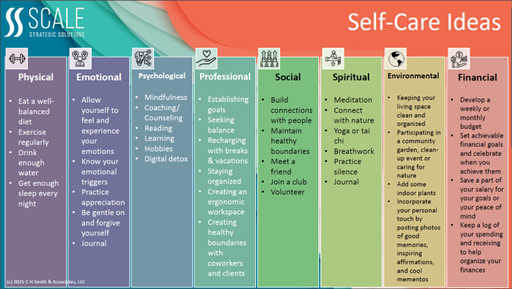
Managers and supervisors set the tone for what is truly valued on their teams. When leaders actively design a workplace for self-care, they design a high-performance organization. In today’s fast-paced work environments, self-care is a leadership responsibility that directly impacts performance, engagement, and retention.
True workplace self-care goes beyond encouraging time off. It requires a holistic approach that recognizes employees as whole people. Scale Strategic Solutions offers a true self-care framework that spans physical, emotional, psychological, professional, and social dimensions. Leaders can reinforce self-care for their teams by encouraging goal setting, creating space for breaks and recharging, supporting mental health conversations, and promoting healthy boundaries with workloads and communication. When these practices are normalized, employees are more focused, resilient, and engaged for better individual and organizational performance.
Organizations that are getting this right are making self-care visible and actionable. Recent workplace wellness insights show that companies are investing in flexible schedules, mental health days, and even digital detox initiatives to reduce burnout and improve retention. Research from Mental Health America also highlights that workplaces built on trust, psychological safety, and supportive leadership significantly improve employee well-being and sense of belonging. These examples reinforce a key point: self-care is most effective when it is embedded into the culture—not treated as an occasional initiative.
What Leaders Can Do Now:
- Identify Self-Care Supports Meaningful to Your Team: Invite your team members to reflect on the kinds of self-care they would find valuable in the workplace during times of stress. Build a team-self-care plan for collective wellness.
- Model the behavior: Take your own breaks, create a clear end to your workday, and respect boundaries. Your team will follow what you do more than what you say.
- Normalize time to recharge: Encourage use of paid time-off, implement “no meeting” blocks for individual work execution, and support real breaks during the workday.
- Build check-ins around well-being: Go beyond task updates. Ask employees how they’re doing and what support they need to stay balanced with effective work performance and personal wellness.
- Create clear boundaries: Set expectations around after-hours communication and workload to prevent burnout before it starts.
- Offer flexible, people-centered options: Whether it is scheduling options, wellness stipends, or mental health days, give employees autonomy in how they care for themselves.
- Foster multiple ways to acknowledge and signal points of stress: People may have different ways they exhibit and communicate stress. Build your skills to recognize stress in your team members. Encourage many ways that team members may communicate their concerns or needs to ensure their personal health and the health of the organization.
At its core, promoting self-care is about creating an environment where people can thrive, not just perform. Leaders who prioritize well-being build stronger teams, reduce burnout, and foster long-term success. When self-care becomes a shared value rather than an individual's responsibility, it transforms workplace culture into one that is sustainable, human-centered, and positioned for growth.
Unsure on how to start developing a team self-care plan? Need help building your leadership skills to advance your organizational culture to balance self-care and organizational performance? Contact us to discuss training and consulting options.